Our CCO and In House Counsel discuss 2017 litigation and complaints trends for the industry in general and TrueAccord specifically. We discuss the reasons why TrueAccord’s legal risk and exposure are so much smaller than the industry’s average.
Bonus addition: TrueAccord’s CCO, Tim Collins, reviewing trends in WebRecon’s January 2018 litigation and complaints trends report.
TrueAccord’s system is machine learning based, but every new product type requires a little bit of tuning to beat the competition. Hear our CSO and VP of Finance in this short podcast about the Conversion Team and what it does to make sure TrueAccord stays ahead of competition.
“I think no matter what direction you look at it from, debt collection in the United States is just broken. Because it takes consumers who want to pay, who could pay and turns them into customers that can’t,” noted TrueAccord CEO and Co-Founder Ohad Samet.
Call centers are risky: expensive to operate, experience high turnover, training and retraining are increasing overhead, and controlling calls is close to impossible because humans are fallible. In this episode, Tim Collins and Ohad Samet compare and contrast a call center based collection operation with TrueAccord’s compliance management and scale: pre-written content, compliance firewall, and other solutions.
Data from the Federal Reserve Bank shows consumer debt has been increasing and hit its peak in 2017 totalling $12.73 trillion, exceeding the previous peak in 2008, with roughly $1.3 trillion in student loans. The expected decrease in regulatory and tax burdens on U.S businesses suggests that the US economy will grow even faster than expected, giving consumers more confidence to spend. This growth in debt volume is accompanied by a change in the profile of consumers that owe it. Millennials are a new type of consumer, and therefore also a new type of debtor. This shift has left the debt collection industry struggling to deliver the type of user experiences consumers demand today. Companies wanting to stay successful, recover debt and retain their positive brand perception must adapt.
Millennials are the new consumers
Millennials have surpassed Baby Boomers as the nation’s largest living generation, according to population estimates released by the U.S. Census Bureau. Millennials are defined as ages 18-34 and in 2015 they numbered 75.4 million, surpassing Baby Boomers at 74.9 million. They are young, highly educated, driven, technology savvy and in significant debt. In 2016 the average student loan debt was close to $40,000 for the millennial generation. Student loans is now the second highest consumer debt category, trailing only mortgages.
Income and debt introduce uncertainty
In a recent survey 68% of millennials have said that debt negatively impacts their life, causing personal and professional stress, and 19% have received collections calls. On average a millennial carries around $5500 high interest credit card debt, to which many add auto loans. According to the Bureau of Labor Statistics an average millennial salary is $35,592, which leaves many dreaming of being debt free but finding that goal impossible to reach. Faced with mounting debt and economic uncertainty, millennials not only communicate and think differently, but are also faced with a substantially different economic reality. When they fall off the debt repayment wagon, they require much more support to get back on it.
A shift in demographics and values
Beyond the economic uncertainty, millennials’ money management habits also differ from those of baby boomers. Millennials place a high value on ephemeral consumption – experiences such as travel rather than goods and investments – leaving them with less long term financial security. Coupled with lower salaries, they are facing a constant struggle between paying off their debt, building financial security, and living in the moment. Helping millennials pay down debt also requires an element of flexibility and financial education to help them start and stay on track with a debt repayment plan that works for their life.
Technology is key
Millennials’ love affair with technology has changed the way companies interact with them and created an opportunity for innovation that spans across all markets from healthcare to fintech and an on-demand economy for pretty much any service imaginable. With 98% of millennials owning a smartphone and using it for more than 2 hours per day, phones are their main source of communication and interaction with the world at large. Organizations need to invest and improve their technology to meet the millennial consumers’ ever changing and evolving preferences.
Personalization is not a good-to-have
This generation puts a lot of emphasis on personal expression and personalization. Individuals express themselves not only by increasingly specific value sets and identities, but also by adopting brands and consumption patterns. Accordingly, millennials expect a higher degree of personalization when they engage with products and services including financial services. Millennials engage with products and services that understand them and connect to their experience, whether it’s expressing oneself through brands or the emotional experience of being in debt. The more variance companies can offer, the more they can respond to consumers’ individual circumstances and get better results.
Looking ahead
To successfully engage with millennials we have to continue to focus on more sophisticated ways to learn from consumer behavior and preferences to offer real-time, meaningful, personal interactions. Millennials are not only the biggest demographic, but they are a maturing one, and are seeking ways to gain better control of their finances and build a more secure future. Properly servicing them and their mounting debt, personalizing and providing customized solutions, is crucial for the future of our growing economy. Issuers and collectors must adapt to this new world or see their charge offs rise rapidly.
Today, consumers engage with service providers and businesses through multiple digital devices and platforms. They expect to be able to research car loan interest rates on their iPad, then see an ad in their Facebook news feed on their desktop, and finally apply for the car loan application on the bank app using their mobile phone. According to a ComScore study, 50% of consumers rely solely on their mobile devices for all of their banking needs. These numbers reveal just how comfortable consumers are with digital communications and banking.
An omnichannel approach creates a consumer experience that is consistent, complementary and seamless as they move across channels. This is now an expected way for consumers to interact with businesses, and that expectation continues into the debt collection process. Surprisingly, many debt collectors are still using phone calls and letters to get the attention of the consumer, but because their methods are so out of date, many customers will ignore or miss their communications all together, leaving a tremendous amount of debt unpaid.
What is an Omnichannel Debt Collection Strategy?
An omnichannel debt collection strategy is a consumer-centric approach to communicating with consumers. It’s a personalized and intelligent strategy of marketing that provides a seamless experience, regardless of channel or device.Consumers can now engage with a company in a physical store, on an online website or mobile app, or through social media. They can access products and services by calling a company on the phone, by using an app on their mobile smartphone, or with a tablet, a laptop, or a desktop computer.
When utilizing an omnichannel debt collection strategy it’s important to note that you’re not just making your website mobile friendly or sending an email reminder once a month. It’s not using multiple channels in order to stay ‘top of mind’ to the consumer. According to TeleTech Consulting, “To succeed with emerging channels, you can’t leapfrog over the basics. Instead, you must build a solid customer experience foundation from which to incorporate all interaction channels. This means setting up people, processes, and technology to identify, differentiate, customize, and interact with customers to meet their needs and resolve their issues.” An effective and precise omnichannel debt collection strategy will use the consumer’s behavior to personalize every interaction and communication in order to nurture the customer through the collections process until their debt is fully paid.
Consider the Customer Journey
Most businesses are aware of their customer’s journey. Consumers take this same journey when paying off their debts, but traditional debt collection agencies or agents are not nurturing their consumer through the process, which leads to ignored calls, irritated consumers, and unrecovered debt.
TrueAccord understands that in order to appropriately nurture the consumer through the process you must use the technology and platforms they are most comfortable with. We reach our consumers through text messaging, email, and push notifications on their devices. The average American spends 4.6 hours a day on their cell phone, but most of that time is spent on apps, searching the web, and texting. A recent study by Informate, found that globally people are not spending time on speaking on their phones. Further, the FCC has warned the American people not to answer any unknown phone calls in order to remain safe and avoid scams. An omnichannel debt collections strategy is the only effective way to meet consumers needs, which is why 95% of TrueAccord’s customers resolve their debt through self-service, online, without a single phone call.
Customer Journey in the Omnichannel Debt Recovery Strategy
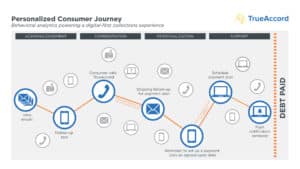
From the consumer’s viewpoint, paying off a debt and making a purchase for a product or a service are very much the same, so it is no surprise that they need the same amount of nurturing and follow a very similar customer journey. TrueAccord uses behavior analytics and machine learning to create a personalized omnichannel debt collections strategy that is seamless and effortless for the consumer.
Every step in the debt recovery process is determined by the consumer’s behavior and needs. TrueAccord consumers will experience an individualized consumer journey unique to them. Personalization coupled with flexibility enables TrueAccord to collect more debt from more consumers. TrueAccord’s customers are able to utilize payment plans to pay off debts because they are easy to set up, offer many choices and nurture and motivate consumers to stay committed with positive messages.
The following chart is an example of one consumer’s personalized journey from debt collections to debt recovered. As the consumer moves through the different stages, the decision engine decides on what channel to use, what content and how often based on the consumer’s interaction with the platform.
Click here to download a larger version of this diagram
Precision in an Omnichannel Debt Collection Strategy
A personalized omnichannel debt collection strategy is a very precise method of interacting with consumers. This is not a throw-it-all-at-them-everywhere approach to consumer communications. TrueAccord’s intelligent omnichannel debt collection strategy will actually communicate less frequently than a call center would, 3 times a week on average. There is no need to call the consumer 10x a day for weeks on end, or to send expensive direct mail letters in various color paper just to be ignored. The omnichannel approach communicates less frequently but much more effectively, reducing call volume by more than 95% and attempting to contact consumers about three times per week. Because the communication responds to each individual consumer’s behavior it has maximum impact resulting in 50-500% more funds collected than traditional agencies.
An intelligent omnichannel debt collections strategy is a relief to today’s consumer. They are looking for a way to take control of their debt and manage it on their terms. TeleTech’s study found that, “simple tools that give customers more say in their interactions can also improve the experience in the long run.” TrueAccord is the tool consumers with debt are looking for. We believe debt collection does not have to be a stressful never-ending process. When consumers are met on terms that make them most comfortable, and given options that suit their needs, they are happy to pay off their outstanding debts.
Today, 64% of consumers approach businesses with the expectation of personalization and streamlined digital access, an omnichannel intelligent approach to debt collections is a necessity for the success of debt recovery. TrueAccord is the only collections platform powered by machine learning, which allows us to meet consumers exactly where they are and guide and nurture them efficiently through their personalized debt collection process until the debt is fully recovered. We view the process through the eyes of the consumer and work to deliver an integrated experience that enables a seamless transfer between channels.
To get a larger version of our customer journey diagram, click here
The year 2017 was full of intriguing developments in the US debt collection industry.
The Consumer Financial Protection Bureau published a report that revealed debt collection was the issue most complained about by American consumers. Along with mortgage-related complaints, debt collection makes up about half of the 1.2million issues raised with the CFPB since it started accepting complaints in 2011.
The Federal Communications Commission adopted a new set of rules aimed at shutting down robocalls, an engagement method which has long been used by traditional collection agencies.
And, despite a growing regulatory pressure matched by increasing consumer demand, the pace of technological and product innovation in the space remained slow.
As we move through the early weeks of 2018, it is time for us to assess how the debt collection landscape might change and advance in the coming year. Here are our predictions for the rest of 2018.
Levels of consumer debt in the United States will continue to rise
Midway through 2017, Nasdaq.com commented that consumer debt in the US was rising at an “alarming” pace. In the second week of 2018, it was clear that that trend shows no sign of slacking, as NowThis reported that credit card debt had reached an all-time high of $1.023trillion. Student loans have become the largest source of household debt outside of mortgages. The most recent reports indicate a total US student loan debt of $1.48 trillion – that’s an average of more than $37,000 per graduate. And the student loan delinquency rate is 11.2%. Car loans are also rising. Automotive News confirmed in September that Americans owe $1.1tr in auto loans – a new record. At the same time, the cost of consumer goods and services is also increasing. The cost of several major areas of household expenditure – including medical expenses, housing, and food and beverages – has increased faster than income growth since 2007. The American economy is strong and shows every sign of remaining so in the coming months. And while the economy remains strong, people across the nation will keep spending. The need for a new generation of consumer-centric, automated, technology-driven debt collection experiences has never been greater.
Traditional methods of debt collection will become progressively less effective
The total recovered by debt collectors has declined steadily in recent years, falling from $13.3billion in 2012 to $11.4bn in 2016. At the same time, the CFPB reports that the net credit card charge-off rate – a handy barometer of the efficiency of debt collection – has risen gradually from a low of 3.8% in the second quarter of 2015 to 4.9% in the second quarter of 2017. One of the reasons why less debt is being recovered is the methods which have traditionally been used. Telephone calls and letters are not how modern consumers want to be approached. They find it easier to block phone calls; they want an interactive, user-friendly solution that is tailored to their needs and allows them to use their preferred technology in a way and at a time that suits them.
There is an app for everything these days. The average internet user now spends more than two hours a day on social media and messaging services. All consumers are spending more and more time online and millennials, the largest demographic in debt today, spend an average of 223 minutes each day – more than three-and-a-half hours – on their mobile devices, up from 188 minutes in 2016. And yet the debt collection space has not seen the sort of technological innovations that will allow it to keep pace with this new mobile-first age. Agencies are reacting by consolidating for scale but, as the CFPB report stated, they are still using the same methods for collection.
The debt collection industry will need to start investing in technology and creating customer-centric experiences
To counter the above trends, it’s imperative that debt collection agencies invest in data-driven technology that allows them to learn about, and understand, the behavior of the consumer. In short, they need to ask themselves the following questions:
How can we have a conversation with consumers?
How do we track their behavior?
How do we then adjust our strategy to ensure better results?
It’s not just millennials. Older demographics also want a more customer-friendly, consumer-focused approach that is driven by digital technology. Consumers want to pay off their debt, but they want to do it in a way and at a pace that is convenient for them. There needs to be a shift in creating tools that make it easier to pay off debt, so more people will do it. That means investing in the technology that allows for a user-friendly, omnichannel approach. Flexibility, convenience and a great user experience are key to more debt being recovered. The industry has to begin its shift to use technology, automate and implement user-centric approaches to collections to keep pace with increasing levels of debt and consumer preferences.
The pace of Fintech innovation will continue to be high
While the gap between spending and debt collection by traditional agencies continues to grow because of a reliance on outdated methods, in the banking and investment spheres there has been a large number of entrants that have quickly gained market share. The wealth management space has seen disruption by newcomers such as Wealthfront, RobinHood, and Betterment offering financial planning and investing for just about anyone. By lowering the barrier to entry and creating great user experiences they have been able to quickly penetrate the market and to go head to head with the more traditional established firms. Challenger brands such LendingClub and SoFi are also re-imagining the lending pace, making it easier for consumers to access alternative loans. These disruptors are bringing great marketing and compelling user experiences as a way to differentiate and gain market share with much smaller teams. As a result, they are challenging and changing consumers’ behavior. The debt collection industry needs to aspire to a similar agility simply to be able to keep pace with this hi-tech innovation.
Emerging companies will need to devise strategies to tackle debt collection
Emerging brands in the consumer space who are looking to grow retention and advocacy will need to address the issue of debt collection. They need to absorb the lessons of the current landscape and integrate optimal collection practices into their customer proposition sooner than later. As well as recovering more debt, this process will by definition help to increase customer retention. Emerging brands tend to focus first on growth and, as a result, they lack the expertise to carry out collections in-house and do not relate to traditional agencies’ methods and values. While they are focusing on their core offering, it is important that they embrace a more forward-looking method of debt collection. They will need collections processes that align with their organizational core values and their customer’s preferences, putting more pressure for innovation in the collections space.
Our CEO, Ohad Samet, recorded a podcast with Lend Academy discussing the positive impact technology is creating in the collections space and the need for more innovation. Will discuss TrueAccord’s unique approach to debt collection using data-driven, digital communications to create deeply personalized consumer experiences.
The podcast also covers the current state of the collections industry and where it’s likely headed as regulatory pressure, consumer preferences and compliance requirements converge. Will cover how TrueAccord is using machine learning to deliver deeply personalized and engaging experiences for consumers while achieving higher recovery rates across various debt types.
Tune in and learn:
The state of the debt collection industry today and where it’s headed
How the use of machine learning is personalizing the debt collections experience for greater conversions
Why code-driven compliance outperforms traditional collections practices by reducing risk to organizations
How understanding consumers’ preferences for easy, self-service options with flexibility empowers more consumers to pay off their debt and get on a path to financial health
How appropriate is it that the Tax Season starts on December 31st? The day before so many of us gear up for our New Year’s resolutions, often involving some sort of fitness goals or better eating habits, but sometimes the best intentions can fall flat, according to US News 80% of New Year’s resolutions fail by mid-February.
There are clear similarities between the mindset that will help you to achieve your fitness goals and the one required to pay off a debt successfully. It’s all about pacing yourself and setting realistic expectations in the beginning. If you set an over-ambitious goal and aim too high, there’s a greater chance that you will quickly become disheartened and abandon your campaign. By setting a steady pace and you will feel accomplished, motivated to keep going, with a much greater likelihood of a positive long-term outcome.
Set realistic goals
We know you that many of you intend to use your tax refunds to pay down your debt. According to a survey conducted by Credit Karma 62% or those surveyed expect to get a tax refund, and 40% of those plan to spend the money to pay down their debt. We want to help you be successful, and help turn your intentions into actions. TrueAccord will start the conversation early, using positive and encouraging content to motivate you towards getting started. We know you have choices to make, and we know that by building trust and creating a positive conversation we can help you to get started with your repayment process, and towards your better financial future.
TrueAccord approach
TrueAccord is leading the way in providing new, easy, digital, customer-focused ways for debt collections process. We are building a process that fits your needs. But even when you do want to pay it off, it can be really hard to get started. You may feel overwhelmed, fear it will take forever, after all, average credit card rates today are around 12.5%, significantly adding to the length of time and payment amounts. This is where the flexibility of payment plans and the best digital user-experience sets us apart from any other collections process you may have experienced.
The power of positive communications and UX
We’re not like traditional, old-fashioned agencies who turn up the heat by making more calls and sending more letters. This is not a user experience that will motivate people to take action, in fact, it can do quite the opposite.
TrueAccord starts the conversation as early as December, building on your own intentions and keeping debt repayment at the top of your mind. We focus on encouraging messages personalized to individual situations, with the built-in flexibility needed to figure out what will work for each consumer. And we give you the tools that make it fast and easy to repay, with on-demand access to a personalized dashboard via a mobile phone, tablet or desktop. It’s part of our mission to redefine the debt collection process by making it more personal and user-friendly.
Choices for a personalized approach
TrueAccord offers a variety of payment plans on a regular basis, and during the tax season, we test more options to give you more ways to get engaged. Some of you may pick to pay a larger sum up front and then smaller amounts going forward, or you may set up the first payment in advance of the refund day, or start out with smaller amounts and gradually increase over time. We test different messages and offer a variety of options to see what works; it’s all part of the personal approach. Again, the similarities with a New Year fitness campaign are compelling. Everybody has a different target and a variety of ways and means to get there. But as long as you feel better, fitter and happier with your financial world by the end of the process, we’ll be happy too.
There are few industries left that are as ripe for disruption as the collections industry is right now. In the case of collections, the old adage of “if ain’t broke don’t fix it” has guided the process for collection agencies for the better part of 40 years. Collectors knew that they could reliably collect on past due accounts by simply sending a letter or two and calling debtors repeatedly until they made contact and then convincing the debtor to pay off the account. Creditors built their customer contracts knowing that the collections model of phone and letter outreach was well established. Today, things are changing and they’re changing fast. Nearly 77% of American consumers own a smartphone. Naturally, consumer preferences on how they want to be communicated with have evolved, and at TrueAccord we’re working hard to stay on top of this trend, while maintaining the highest standard of compliance, and pushing the industry to catch up to the times.
The collections practices set out by the Fair Debt Collection Practices Act (FDCPA) were designed primarily to protect consumers from abusive contact by collectors in person, by phone, and by letter, but gave little thought to new technologies or how they would be used by consumers. It was only last year that the new proposed rules on debt collection were announced by the CFPB referencing new digital communications methods. This announcement has been creating waves for both creditors and debt collectors and now is the time to start thinking about consumer communications preferences and how to leverage new communications tools to contact your customers, even in collections.
The legal standards for how to obtain consent to contact a debtor is outlined in regulations and in basic agency law. In almost all cases consent to contact a consumer transfers to an agency. Most creditors have added to their contracts provisions allowing for consumer contact by mail and phone with some forward thinking creditors including consent language for the creditor to service the account using email or even better, digital communication channels. However, not many contracts underlying a debt that gets placed in collections anticipated a collector wanting to contact a debtor by email or text message. With new rules coming, now is the time to anticipate this change and create broad consents that incorporate digital channels that currently exist, and that may be created. An example of a broad consent in a contract might look like:
“If we need to contact you to service your account or to collect amounts you owe, you authorize us (and our affiliates, agents, contractors and third party servicers) to contact you at any number you provide, from which you call us, or at which we believe we can reach you, at any email address you provide to us or at which we believe we can reach you, or through any social media or other digital communications platform you may use. We may contact by calling or texting. We may contact you using an automated dialer or prerecorded messages. We may contact you on a mobile, wireless or similar device, even if you are charged for it.”
This clause incorporates phone, email, text, social media, and leaves the door open for new technology like push notices. Even though there is some uncertainty around the ability to contact consumers using all of these new channels it’s important to think ahead for when the laws catch up to consumer preferences. It’s not uncommon for a consumer to reach out to TrueAccord and ask for us to text them account details and we wouldn’t be surprised if a consumer asked us to contact them using other messaging apps like Whatsapp or Facebook Messenger. With the consent language above a collector could respond to consumer demand and use these channels to contact a consumer in the way they want to be reached. Respecting consumer preferences will open the door to more successful collections opportunities benefiting consumers, collectors, and creditors.
TrueAccord is a machine-learning and Al-driven 3rd-party debt collection company that is reinventing debt collection. We make debt collection empathetic and customer-focused and deliver a great user experience.
Our digital-first approach to debt collection creates a cycle of collections growth:
1. Improve the perception of the industry
2. Provide a personalized experience
3. Build brand equity and collect