Free eBook: The Basics of Compliance in Debt Collection

By on March 24th, 2015 in Industry Insights
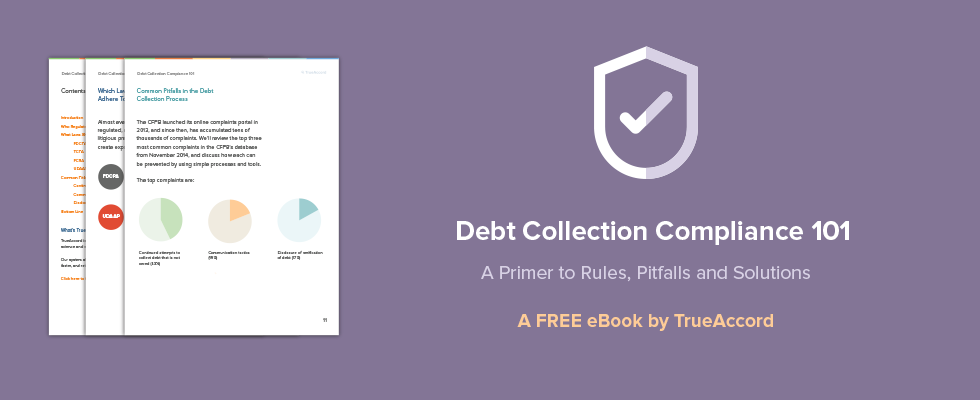
compliance ebook

collection-compliance-cover

Debt collections is a litigious market. Whether debt collectors sue debtors for payment, or the cottage industry of consumer advocates that evolved to sue for every technical violation, you’re bound to get your day in court. Couple that with a strong Federal regulator and public scrutiny, and it’s obvious why you need to learn more about regulation and how to adhere to it.

If you’re just starting to learn about debt collection, this free eBook will give you a first taste:

  • Learn who regulates debt collectors
  • Get an introduction to the relevant Federal rules
  • Learn about the top complaints debt collectors face, and how to prevent them

Ready to get an introduction? Download our eBook and learn more!
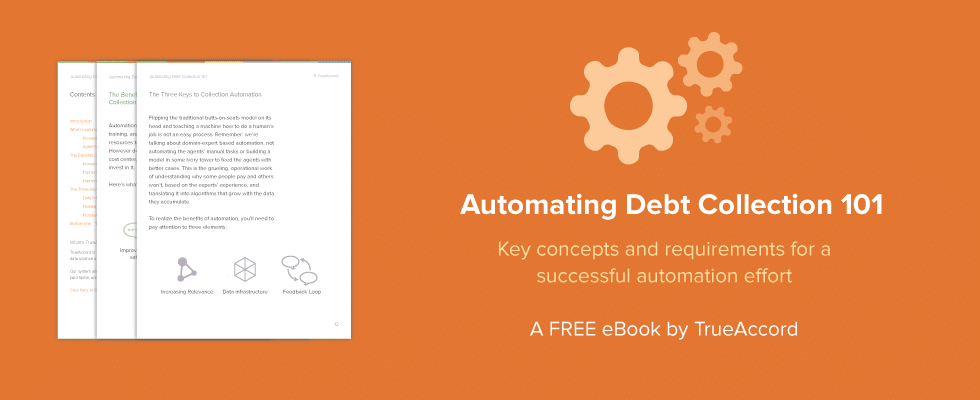
Free eBook: Automating Your Debt Collection Process

By on March 17th, 2015 in Industry Insights
automating debt collection

automation-collection-cover

TrueAccord was built as an automated system from day one. Customer care experts handle the cases that needed special care, and teach the machine how to improve. We learned how to do that through a lot of hard work and testing, and we’d like to share some of that with you. In this free eBook, you’ll:

  • Learn about the different types of automation
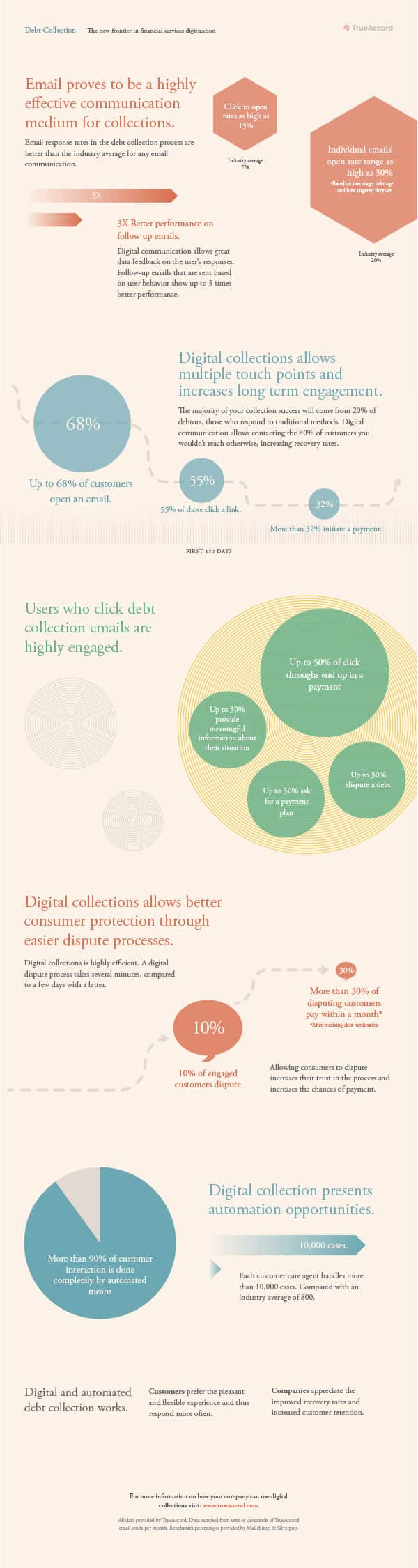
  • Read from TrueAccord’s experience about the benefits of automation
  • Read about the three keys to a successful automation project

Click through and download it!


The three things to do when you interact with a debtor

By on February 18th, 2015 in Industry Insights
three things interact

Getting a debtor on the line, or to respond to an email, is a hard task. Customers don’t end up in this point if they have money and intend to pay promptly. Therefore, once you do talk to them, it’s important to use that time in the best way possible. There are three things to pay attention to when interacting with a debtor:

  • Instill a sense of urgency
  • Get the truth
  • Counter the excuse

Instilling A Sense Of Urgency

If your approach to getting paid is laid back and non-committal, your debtor will take this approach as well. When you communicate with late customers, you must demonstrate that the issue is urgent and important in order to get their attention and move them to action.

Getting The Truth

Sometimes the truth sounds like an excuse. Your debtors might be in real trouble or they might be tricking you. Asking the right questions will help you determine the facts and act accordingly.

Countering The Excuse

Once you’ve established you are hearing an excuse, you need to counter it in a way that makes sure you won’t need to deal with it again for this debtor.

Did you find this helpful? Download our free eBook “The Top 4 Excuses Debtors Make” and learn more about how to counter common excuses.

Moving to digital collections without losing conversion

By on February 13th, 2015 in Industry Insights
TrueAccord Blog

Collection operations base their high recovery rates on models allowing optimal utilization of collectors’ time. Since the person to person call is almost the only available too to convert debtors into paying customers, every minute is important. It’s obvious that self-service portals cannot bridge that gap on their own, because they won’t capture intent to pay in exactly the same way.

While we may never be able to move away from making phone calls, the user experience in the collection process can and should be adapted to use behavioral cues to capture payment intent. Thinking of the set of tools as a spectrum, with a high touch phone call on one end and a low touch self-service portal on the other, modern technology allows us to maintain contact with the customer more consistently and longer than before. The key, as discussed in the webinar embedded below, is in designing the experience to use the way we think to capture that intent.

In this webinar about behavioral economics in debt collection, we explore the mechanisms that drive decision in humans, and how to work with these mechanism to identify when a customer is ready to pay, or able and just needs a small nudge. These mechanisms are in the heart of every effective online experience, and they are explained here with their relevance to the debt collection process, with real life examples.

What is the Lending Club debt collection process?

By on February 10th, 2015 in Industry Insights
lendingclub

As of Q3-14, more than $6 Billion have been borrowed on Lending Club. The p2p lending platform allows individual investors to lend to consumers for various needs – most often, credit consolidation – and get a hefty interest in return. Most of the loans on Lending Club are paid back, but some of them don’t. We estimate that default rate at 5-7% overall, and naturally much higher when the loans are riskier. Borrowers pay their loans back via a monthly ACH payment, split and applied to all the notes that make up their loans, with the different lenders whose money they got. What happens when the note defaults? How do you see what happened? What is the Lending club debt collection process? Let’s take a look at the Lending Club interface and find out.

Continue reading “What is the Lending Club debt collection process?”

Is the number of collection lawsuits the right KPI for the industry?

By on December 6th, 2014 in Industry Insights
TrueAccord Blog

Both the ACA and Credit and Collection Risk today shared numbers from the latest WebRecon report about debt collection litigation and CFPB complaints. The report and the response to it demonstrate how the debt collection industry works.

Almost no collection agency will tell you how it works to recover debt. Sometimes because its clients don’t care – or don’t want to know – as long as they don’t get in trouble or get sued. With this mindset, it’s no wonder that agencies are almost giddy about this or that type of lawsuit declining to an all time low. Since no other performance metric is shared, CFPB complaints and lawsuits become the number every company optimizes for – since only what gets measured, gets noticed.

Continue reading “Is the number of collection lawsuits the right KPI for the industry?”

Top 3 reasons you lose engaged customers

By on October 7th, 2014 in Industry Insights
TrueAccord Blog

It’s natural to blame your customers for not paying, but before you accuse them of bad behavior, make sure your own house is in order. Rule number one in algorithmic recovery is to approach debtors from a CRM perspective as opposed to a disciplinary one. With this strategy, it’s far more likely you’ll get customers back on regularly paying terms for the long run.

Continue reading “Top 3 reasons you lose engaged customers”

On the fence about TrueAccord? Check out our success with Elance-oDesk.

By on September 22nd, 2014 in Industry Insights
odesk business case

It’s easy to sum up our success with Elance-oDesk: for every $1 of debt we recovered, they have seen more than $2 of additional, post-recovery payments from these customers. These are pretty compelling numbers. For perspective, let’s rewind.

Elance-oDesk is one of the world’s largest online workplaces. More than 2.5M businesses and more than 8M freelancers converge on www.elance.com and www.odesk.com to work together via the Internet. By the end 2014, the merged companies expect to see more than $900 million in billings. However, before TrueAccord, many of those billings had gone awry.

Continue reading “On the fence about TrueAccord? Check out our success with Elance-oDesk.”