Collection operations base their high recovery rates on models allowing optimal utilization of collectors’ time. Since the person to person call is almost the only available too to convert debtors into paying customers, every minute is important. It’s obvious that self-service portals cannot bridge that gap on their own, because they won’t capture intent to pay in exactly the same way.
While we may never be able to move away from making phone calls, the user experience in the collection process can and should be adapted to use behavioral cues to capture payment intent. Thinking of the set of tools as a spectrum, with a high touch phone call on one end and a low touch self-service portal on the other, modern technology allows us to maintain contact with the customer more consistently and longer than before. The key, as discussed in the webinar embedded below, is in designing the experience to use the way we think to capture that intent.
In this webinar about behavioral economics in debt collection, we explore the mechanisms that drive decision in humans, and how to work with these mechanism to identify when a customer is ready to pay, or able and just needs a small nudge. These mechanisms are in the heart of every effective online experience, and they are explained here with their relevance to the debt collection process, with real life examples.
As of Q3-14, more than $6 Billion have been borrowed on Lending Club. The p2p lending platform allows individual investors to lend to consumers for various needs – most often, credit consolidation – and get a hefty interest in return. Most of the loans on Lending Club are paid back, but some of them don’t. We estimate that default rate at 5-7% overall, and naturally much higher when the loans are riskier. Borrowers pay their loans back via a monthly ACH payment, split and applied to all the notes that make up their loans, with the different lenders whose money they got. What happens when the note defaults? How do you see what happened? What is the Lending club debt collection process? Let’s take a look at the Lending Club interface and find out.
Congratulations! You signed up to use the best debt collection platform in the market, and you’re all ready to recover the money your customers owe you. How do you start?
Both the ACA and Credit and Collection Risk today shared numbers from the latest WebRecon report about debt collection litigation and CFPB complaints. The report and the response to it demonstrate how the debt collection industry works.
Almost no collection agency will tell you how it works to recover debt. Sometimes because its clients don’t care – or don’t want to know – as long as they don’t get in trouble or get sued. With this mindset, it’s no wonder that agencies are almost giddy about this or that type of lawsuit declining to an all time low. Since no other performance metric is shared, CFPB complaints and lawsuits become the number every company optimizes for – since only what gets measured, gets noticed.
It’s natural to blame your customers for not paying, but before you accuse them of bad behavior, make sure your own house is in order. Rule number one in algorithmic recovery is to approach debtors from a CRM perspective as opposed to a disciplinary one. With this strategy, it’s far more likely you’ll get customers back on regularly paying terms for the long run.
It’s easy to sum up our success with Elance-oDesk: for every $1 of debt we recovered, they have seen more than $2 of additional, post-recovery payments from these customers. These are pretty compelling numbers. For perspective, let’s rewind.
Elance-oDesk is one of the world’s largest online workplaces. More than 2.5M businesses and more than 8M freelancers converge on www.elance.com and www.odesk.com to work together via the Internet. By the end 2014, the merged companies expect to see more than $900 million in billings. However, before TrueAccord, many of those billings had gone awry.
If you’re a marketing or customer service manager at a large bank, your success is likely tied to increasing your institution’s Net Promoter Score. You’re probably also familiar with the paradoxical task of collecting debt without sacrificing promoters. The age of big data has a solution for that. With the right collections partner, you can improve customers’ attitudes not just about the late bill at hand, but about their overall experience of the brand itself.
How is this possible?
For starters, it’s an essential evolution in the financial industry. According to Satmetrix, credit card providers face a particularly onerous challenge in debt collection because it typically takes six or more years before any one customer becomes profitable. In their attempt to maximize customer spending and tenure, lenders must innovate in the realm of debt repayment.
If satisfaction is the fundamental NPS driver, it stands to reason the most valuable innovations in customer service will focus on turning critics into advocates. Finding disgruntled customers is easy. Many of them are refusing to pay their bills. At TrueAccord, we’ve found that winning back these types of customers can create some of your strongest advocates.
Recover relationships, not just sums.
TrueAccord’s proactive loss management system uses enterprise-grade analytics to personalize our approach to individuals – to connect with them as humans – in a way that not only gets you paid but wins you fans. We accomplish this by looking at root causes of delinquency rather than the past-due balance itself. We segment customers based on how they perform both before and after we point out their tardiness. And we know how and when to follow up.
Take it from one of our best testimonials: “This has to be the funniest bill collection I have ever received and it actually made me want to pay.” The creditor in question could have written off this customer. Instead, we created a promoter.
We’ve also found that in addition to driving an organization’s NPS, TrueAccord’s debt collection methods can increase a company’s overall revenue. Our customers see more than $2 in additional business for every $1 paid per late payer we retained for them.
Bring it home.
A seminal Bain survey of more than 89,000 customers of various types of US banks found that promoters stay longer with their institutions, buy more products, refer more new customers and cost less to serve. The study also found that among affluent US customers, a promoter is worth $9,500 more than a detractor over the tenure of that customer relationship. Of particular note, direct banks enjoy drastically higher NPS than national branch networks based on recommendations from friends, colleagues and family members.
At TrueAccord, we can make your customers feel like they’re dealing with their local banker down the street. And as history suggests, communities promote from within.
Ever wondered why people make the choices they make, and how you can help them make other choices? Ever wondered whether talking or writing differently can help you get paid more, and more often? If so, you should attend our webinar about behavioral economics in debt collection.
We’ll go over customer psychology, influence mechanisms and how to tap into them. Click here to sign up!
Your accounts receivable team stands between you and your cash. That’s too much power to be taken lightly. To successfully carry out their duties, AR professionals require immense insight and finesse. They’re not just enforcers; they’re part of your CRM team. And if they’re not properly informed, they can cause lapses in compliance that can imperil your business far more than a few late payments – especially if you’re an SMB.
Here are the top three qualities to look for in an effective AR professional:
They are respectful toward customers.
First off, it’s critical you hire someone who will approach your customers with respect. In fact, an unskilled AR person was our catalyst in founding TrueAccord. Rude bill collectors might get one bill paid, but you’ve probably lost that customer for good. There is a demonstrated economic upside to retaining even the customers who don’t pay on time. It’s also worth pointing out that cash is not the only form of currency you can receive. AR people are also in a position to uncover strong customer insights that can enhance the brand experience for everyone. Sometimes it’s not the talking, but the listening, that drives your bottom line.
The ideal AR professional should be able to think holistically about your business. They should understand your overall goals and be familiar with fundamental business principles, such as the relative ease in retaining versus winning a customer. Most importantly, they think of themselves as brand ambassadors from the moment they send the first invoice until receipt of final payment. Check out our short e-book on the topic.
All of that said, there are some situations too big for a single AR person or even an AR team to handle. Scouring the web for AR best practices is not always enough for SMBs to effectively leverage what is often one of their largest liquid assets. TrueAccord specializes in advanced methods of collecting debt and can step in at any time with proven methods to dissolve an impasse.
What’s Debt Collection? How does it work? What is the State of Debt Collection in 2014?
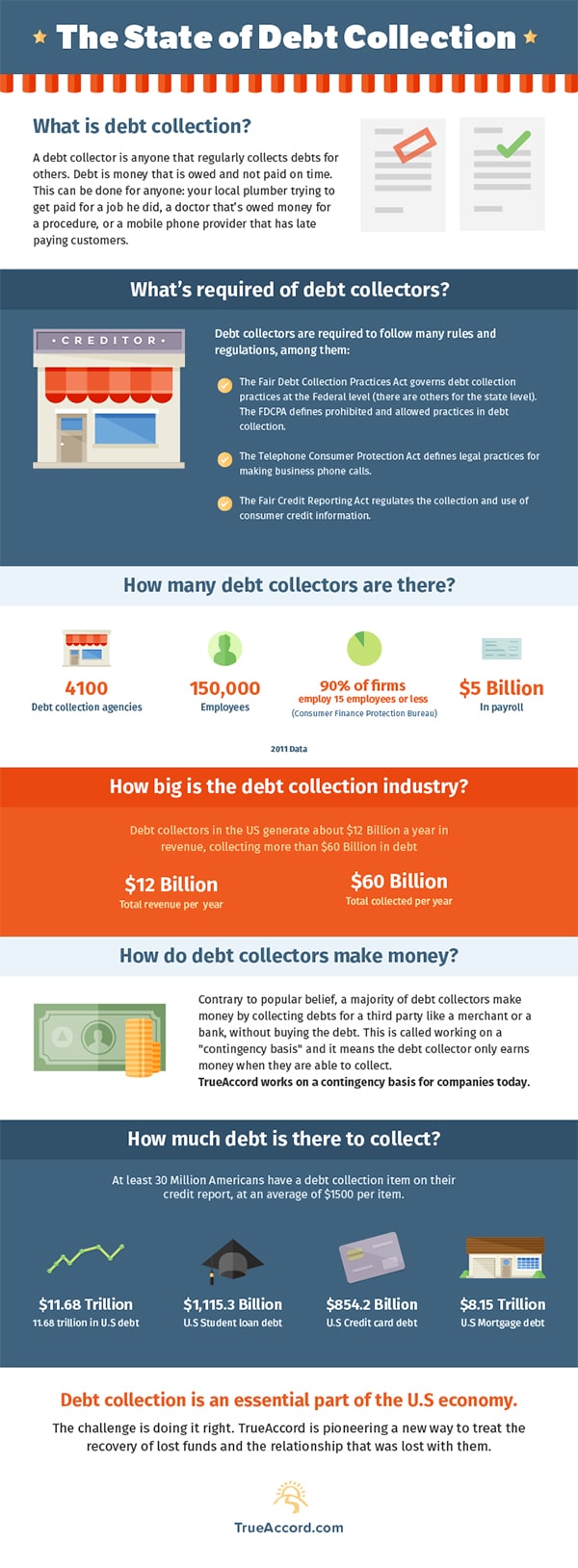
Debt Collection is a hotly debated industry in 2014. With more enforcement action and more consumers getting into debt, many hold to firm opinions about the pros and cons of the trade. To help the discussion with some facts, we’re proud to present TrueAccord’s 2014 State of Debt Collection infographic. Here’s you’ll find answers to common questions and misconceptions like:
Debt collectors only buy debt for cents on the dollar and collect as much of it as possible (wrong!)
Debt collection is loosely regulated (absolutely wrong!)
There is a lot of money in debt collection (true indeed)
TrueAccord is a machine-learning and Al-driven 3rd-party debt collection company that is reinventing debt collection. We make debt collection empathetic and customer-focused and deliver a great user experience.
Our digital-first approach to debt collection creates a cycle of collections growth:
1. Improve the perception of the industry
2. Provide a personalized experience
3. Build brand equity and collect