Consumer behavior and expectations have undergone significant changes over the past few years – trends that COVID has only accelerated. For lending organizations, the end result of these changes is that digital collections have shifted from a “nice to have” into a must-have.
Here are the four consumer trends that are disrupting the traditional collections model and making digital-first collections a necessity:
Consumers are digital-first.
The decline of the landline has made it harder to reliably reach consumers at home. And advances in mobile technology (e.g., call blocking) have made it easier for consumers to screen calls. As a result, right-party contact rates are low and continuing to decline. In fact, 78% of collection agents see their calls blocked, and 74% of collection agents see their calls marked as “Spam or Fraud.” (Source: ACA)
What this means for lending organizations Organizations must embrace a multi-channel digital approach that meets customers where they are, empowering them to respond at their own convenience.
The explosion of personalization in marketing (from product recommendations to programmatic advertising) means that consumers expect to be communicated with as individuals, in a way that is relevant and tailored to them.
What it means for lending organizations Organizations must seek out a digital collections approach that tailors messages and outreach to individual consumers.
Consumers expect a seamless, self-serve experience.
From Amazon to Instacart, consumers have become accustomed to being able to do everything digitally – without interacting with a human being.
What it means for lending organizations It’s not enough to communicate with customers over digital channels. A digital collections solution must offer a robust and intuitive self-service interface that enables customers to engage in their own time.
There are now major logistical challenges in scaling the contact center model.
With COVID limiting in-person interactions, it’s more challenging than ever to hire, train, house, and monitor contact center agents – creating obstacles with the traditional agency model.
What it means for lending organizations A digital collections solution must be built for scalability, enabling organizations to meet collections volume without adding agents to make outbound calls.
As we begin 2021, we’re looking ahead and seeing a lot to be optimistic about in the world of collections. Our industry is becoming more innovative and more consumer-focused. Digital channels, self-serve options, & machine learning create a new industry normal in which both collectors and consumers can succeed.
Get on the path to becoming a best-in-class collector this year. We’ve compiled our favorite tools and resources into a Digital Collections Roadmap. The resources on this map will help you assess your current processes, learn about industry benchmarks, and build a more innovative and consumer-focused collections operations in 2021.
We’re only one week into 2021, and it’s already an eventful year. The surging pandemic, lagging vaccine rollout, imminent political change, and turmoil in Washington are affecting every corner of the country, including the worlds of finance, fintech, and collections. Here are the articles we’re reading to help make sense of what this year may bring:
• Part 2 of the CFPB’s new debt collection rule is here. New guidelines around validation notices, time-barred debt, and passive debt collection are all covered in this section. Kelly Knepper-Stephens, TrueAccord’s VP Legal & Compliance, will be sharing her insights on the new rule at the ACA Huddle Webinar this Friday 1/8 (ACA log-in required). If you want to go even deeper on Part 2 of the new rule, you can download all 354 pages here.
• If you’d rather look forward than back, we recommend checking out Tearsheet’s expert panel on what banking will look like in 2021. As longtime proponents of consumer-focused financial services, we love this prediction in particular: “Banks will have to find a way to duplicate personal, in-person relationships–but at scale and with a digital-first approach. This will be a priority in 2021.” To learn about TrueAccord’s method for creating innovative, personalized experiences in collections, check out our webinar on the future of digital debt collections.
Reaching consumers where they are, with the use of digital strategies
Streamlining assistance programs to make them more accessible for consumers
Developing partnerships with faith-based & community organizations
Educating Consumers about Assistance Programs
Utilities companies have found it both necessary and effective to educate customers on various assistance programs. The Low Income Home Energy Assistance Program gives families a cash grant to pay for their heating bills, or payment assistance programs that give families monthly credit based on a household’s income and energy use. For those that do not qualify, there are deferred payment plans or Customer Assistance Referral and Evaluation Programs (CARES), like the one that the Pennsylvania Public Utilities Commission set-up to assist family emergencies. However, even with the right messaging and the right programs, there’s still challenges in reaching consumers.
Reaching Consumers Where They Are
Communication methods are quickly moving digital. Consumers are increasingly finding phone calls disruptive, and traditional letters pile up or are simply thrown away. To reach the most consumers, emails, calls, social media, and text messages are now table-stakes. Though over 60% of millennials are burdened by debt, they expect highly tailored experiences, mobile-optimized payment portals, and extensive use of social media. To reach other demographics, some utilities are exploring radio, television commercials, and other creative solutions. One organization repurposed a fleet truck and traveled to food banks to educate low-income consumers on assistance programs. Another organization hosted a virtual tradeshow to help consumers navigate paperwork and helped over 4,900 of their customers complete applications on the spot!
Streamlining Assistance Programs
On the ground, many utilities found that consumers simply did not have basic access to the internet, lacked the time to complete an application, or found the bureaucratic process confusing and cumbersome. With that in mind, some utilities created a one-stop shop to merge assistance applications so if consumers did not qualify for a low-income program, they might qualify for a government grant or a deferred payment program. Another utility partnered with the Department of Human Services and had their representatives certified to complete state emergency relief applications with customer consent, which greatly aided the elderly’s ability to complete applications.
Developing Partnerships with Organizations
Lastly, some utilities are building grassroot support to develop partnerships with trusted community organizations and churches. Because these organizations have an unparalleled reach and trust, many utilities can use community spaces, rely on trusted sponsors, use co-branded email campaigns, and leverage intimate knowledge of their network to tailor outreach and programs to increase awareness.
Summary
With only an hour to talk about these topics at the roundtable, our team at TrueAccord and the participating utilities all felt like we needed to host another virtual event in 2021. If you’re interested in participating in a future roundtable, please email Matt Buffalini at mbuffalini@trueaccord.com.
Between the COVID-19 vaccine rollout, a potential second stimulus package, and the incoming Biden administration, big changes are upon us in the United States. How will these changes impact the worlds of finance, fintech, and collections? Here are the headlines we’re watching as we consider the changes to come in 2021:
• On the fintech front, we are still closely watching the rising success of BNPL (Buy Now Pay Later) startups, such as Affirm, Afterpay, and Klarna. PYMNTS.com recently released a study, Buy Now, Pay Later: Millennials and the Shifting Dynamics of Online Credit, that sheds light on the audience factors encouraging this emerging landscape. As we’ve noted before, flexible payment options can be a real win-win: better for the customer experience, as well as a positive for payment plan retention.
As we speed towards the end of a tumultuous year, I wanted to share my thoughts on what the months ahead may bring for the collections industry.
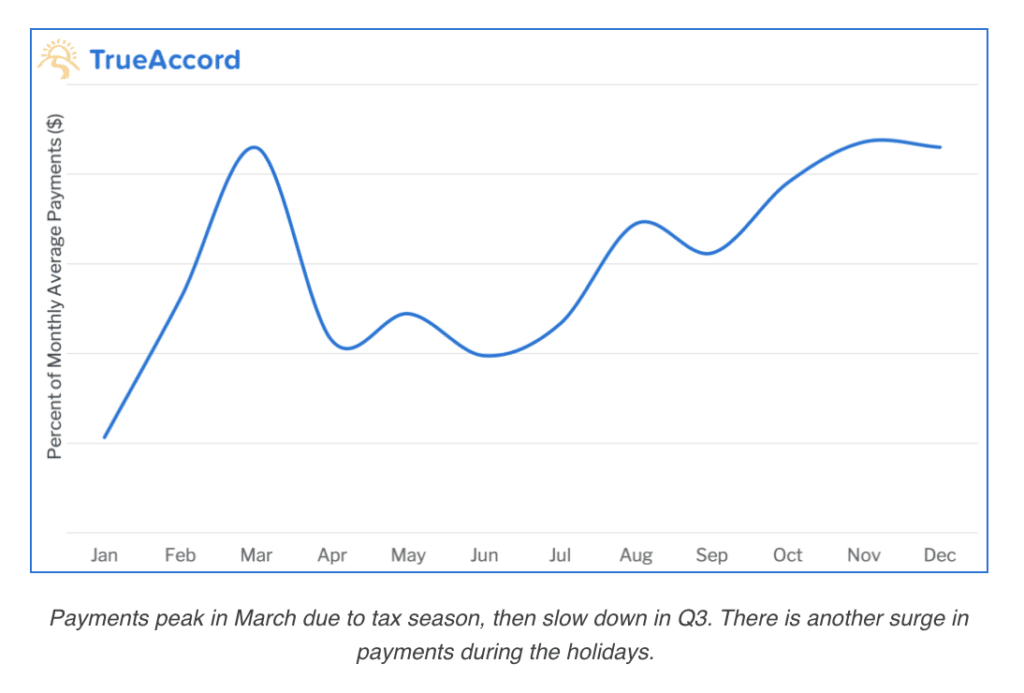
First, to address the riddle in the title of this post, what do the holidays and tax season have in common? Debt repayment. According to TrueAccord’s data from 12 million American consumers, debt repayment typically peaks twice a year: once during the winter holidays and again from February to early April when tax refund checks are received.
But those aren’t the only factors that may affect debt repayment in the near future. A second COVID stimulus package may be around the corner, and if the first stimulus package is any indication, that may lead to an increase in the number of Americans who are choosing to pay off debt. (In 2019-2020, there were not two, but three peaks in debt repayment—the winter holidays, tax season, and April-May, when stimulus checks were delivered.)
So, what will be the impact of a high debt repayment season coupled with an economic stimulus? A sharp and potentially unprecedented increase in debt repayment might be coming very soon.
If you’re worried about scaling your collections operations to effectively meet the increase in payments, reach out to TrueAccord. We put the consumer in the driver’s seat: 96% of consumers we work with resolve their debts through self-service on our digital channels. That high level of automation enables TrueAccord to run very lean, averaging 80,000 active accounts per agent.
At TrueAccord, we are changing the lives of the 77 million Americans in debt and leading the digital transformation of the collections industry. We’d love for you to join us.
TrueAccord released Ten Critical Questions: The Buyer’s Guide to Digital Debt Collections Solutions. The ebook is the definitive guidebook for organizations looking to jumpstart their digital debt collection journey.
“We wrote this book to distill what we’ve learned after many years in the industry,” said Sheila Monroe, TrueAccord Corp. CEO. “There’s no question that digital-first debt collection delivers superior results for creditors and a better experience for consumers. But not all solutions are created equal.”
The Buyer’s Guide starts with four key trends that explain why digital debt collection is the wave of the future. It then lays out the critical questions that organizations should ask before entering into a partnership with a digital debt collection vendor.
The ebook equips potential buyers with benchmark data and insights into key questions like:
What channels do you use to reach consumers?
Do you use advanced technology like machine learning? If so, how?
What percentage of customers resolve their debt through self-service, without any human interaction?
On average, how many accounts does each agent handle?
“Ultimately, our goal is to give collections and recovery professionals the tools they need to navigate a complex landscape and select the best digital collections solution for their organization – and their consumers,” said Monroe.
In this edition of The Digest, we’re zooming in on a topic making headlines in the world of collections: the new CFPB debt collection rule. We sat down with TrueAccord’s Chief Compliance Officer Tim Collins to get his initial thoughts on what the new rule will mean for the collections industry, and how it may open new doors for better relationships between collectors and consumers.
Tim, thank you for sharing your thoughts on the long-awaited new CFPB debt collection rule. It’s the first big change to the FDCPA since 1977, and it provides new “rules of the road” for collections. What are some of the top takeaways for the collections industry?
As you said, this is the first major change to the FDCPA in over forty years. The new rule is meant to help the collections industry adapt to all the exponential changes in technology, communication, and consumer behavior that have happened since then.
To some degree, there is still a focus on regulating the more traditional world of call-and-collect agencies. There are new guidelines around call caps. They also put in a clearer definition of limited content messages, which was a topic that the industry was looking for guidance on. In general, there are now clearer instructions on the means by which a collector can reach a consumer.
Beyond the world of call-and-collect agencies, the new rule opens doors for better digital communications with consumers—email, SMS, etc. There’s a huge focus on consumer preference. The new rule is clear: the consumer has the right to tell you when is a good time for them to be contacted, and they have the ability to tell you what communications channels work best for them. All of that is very much in line with what we already do—and have always done—at TrueAccord.
The new rule is clear: the consumer has the right to tell you when is a good time for them to be contacted, and they have the ability to tell you what communications channels work best for them.
I know TrueAccord was influential in issuing comments that were ultimately incorporated into the rule. Can you tell us a bit about that?
We’re proud to have been involved in providing public comments to the rule around the use of email in collections. We were able to share our insights on how emails should be sent, why email is convenient for consumers, the advantages of email with opt-out, and other dimensions of a successful, compliant email program.
It’s important to note that the new rule won’t take effect until late 2021, and there’s a lot that could change between now and then in the United States. So, there’s still some degree of uncertainty about how the rule will be implemented.
That’s right. There’s a lot of things that could happen between now and when the rule becomes effective. Also, we’re still waiting for part two of the rule to come out. That will likely happen in December.
So yes, there’s a lot that we still don’t know, and a lot that could change. There’s even a chance the whole rule could be tossed out, though that is unlikely. But right now, the new rule gives us a vision and a direction about where the industry is headed— and that is towards better alignment with consumers, more protection for consumers. That’s part of the CFPB’s mission, and that’s part of our mission as well.
This interview has been edited and condensed for clarity.
* TrueAccord’s compliance and digital collections experts are available to talk more about the CFPB’s new debt collection rule and what it will mean for the collections industry. Start a conversation with our team to learn more.
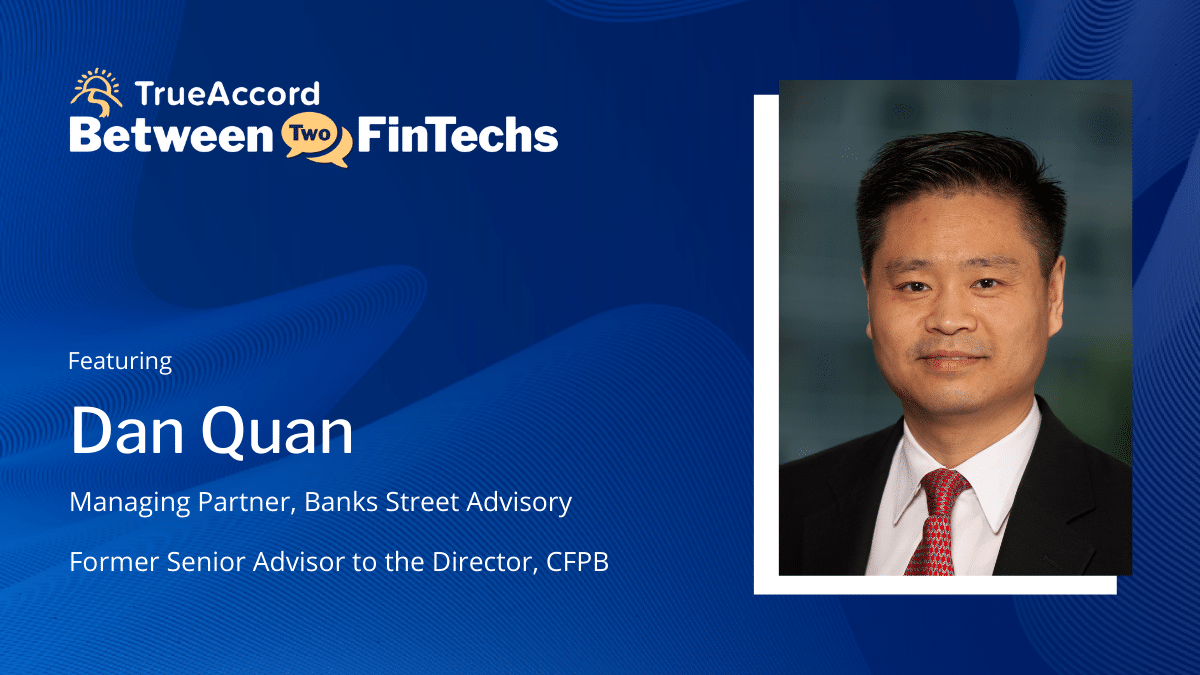
In this edition of “Between Two Fintechs,” TrueAccord founder Ohad Samet interviews Dan Quan, Managing Partner of Banks Street Advisory and formerly the Senior Advisor to the Director at the Consumer Financial Protection Bureau (CFPB). Dan led its fintech office, Project Catalyst, the first of its kind in the world, inspiring regulatory agencies across the globe to set up dedicated innovation hubs to promote financial innovation.
At the CFPB, Dan focused his work on consumer-permissioned data access/open banking and the use of AI and alternative data in credit underwriting. A nationally recognized fintech thought leader, Dan serves as a bridge between Silicon Valley and the Beltway, and we’re honored to feature him in this series.
This transcript was conducted in October 2020 and has been edited and condensed for clarity. You can see all the interviews here.
Ohad Samet: Welcome Dan, we’re so excited to speak with you today about your experience working with fintechs at the CFPB and your perspective around regulation, technology and consumer financial services.
Dan Quan: Thank you. Fintech companies, like yours at TrueAccord, are a really exciting sector.
In the earlier days at the Bureau, I remember walking into the office the first day, and it was a conference room with 20 computers. We had to work or have meetings in the hallway or kitchen. The Bureau’s staff mindset was, this is once-in-a-lifetime thing. I believe the Bureau was the first agency that recognized the promise of fintech. We got a lot of good information and data from folks like you to help the Bureau write better rules and make better policies.
OS: Yes, it’s been very interesting to work with the Bureau’s research department, and be able to provide anonymized aggregate data to support the Bureau’s requests for comment. But it’s not like you guys were very gentle on the enforcement side. There were a lot of inspections of FinTech companies, so without asking you to comment about specific issues, I’m wondering about how you found the balance between encouraging innovation but also enforcing regulation?
DQ: I think it’s really a balancing act, right? I will say there’s one common misconception about the CFPB: that there was never a “human side of the Bureau.” When we talk to companies, we also recognize that enforcement is a very blunt tool. It’s very effective, it shows results immediately, but at the same time it also can crush a business. It also doesn’t really help the market come up with better solutions.
How can you come up with better products to not only comply with the regulations, but also serve people better? Obviously, the work we did at Project Catalyst, the innovation office was trying to do that.
Informal conversations, interactions or idea exchanges with market participants are just as valuable. If you ask me what I’m most proud of that I did at the CFPB, it was the effort to push open banking in the United States. It involved so many conversations and research from various market participants from financial institutions, from think tanks, data aggregators, users, nonprofits and consumer advocates.
OS: Yes, I think it’s very satisfying for me, and I hope by extension to the team in general. The work that we’re doing gave federal regulators enough data needed to make these decisions. That was a very positive experience of being involved in federal policy even if we’re just a tiny cog in the machine Pivoting a bit, there are a lot of new fintech solutions, such as microlenders like Dave, or those giving employees access to their payroll early, like neobanks and Earnin. What are you seeing in terms of trends in federal policy and how they’re thinking about this new crop of solutions.
DQ: You mentioned companies like Dave, Earnin, PayActiv, starting with earned wage access—allowing people to get to their paychecks anytime on demand with a small fee or sometimes just a tip or for free. Chime and Varo started doing this too, plus adding overdraft protection programs. They are all challenging the status quo. That’s going to be bad news for banks who rely on fee income. What’s interesting is that these new product offerings from such fintechs are merging to offer solutions that try to make their customers live a financially healthy life.
A lot of conversations are actually at the state level, whether these are payday lenders, or whether they actually are a better alternative to consumers. We shall see how things are going to play out in the next couple of years.
OS: You mentioned state-level attention, which reminded me of the discussion in the last few years around, if the CFPB is less active, state AGs are going to pick up the mantle and be more active. No one is an oracle, but what are some possible scenarios from your perspective for the CFPB after the elections?
DQ: I would imagine if President Trump is re-elected, we’ll see the status quo where there will be continuous fights between federal and the state regulators. States may think the CFPB is not doing an adequate job, whether that’s true or perception and will want to come in and fill the gap, which is manifesting itself in California, right? But I also want to point out one thing we should still realize is that there are still a lot of collaborations between the CFPB and the states.
If Biden becomes the president, I think you will see more collaboration. In the case of California, once their consumer finance agency is set up, they are not going to walk that back.
I believe it’s always better to talk to regulators, to help them understand what you do, as long as you’re a good actor—rather than operating in the dark, and have no idea what kind of rule is going to come down at you in the future.
OS: For our last question, can you talk about the challenges for regulation regarding machine learning? I think we’ve spent a lot of time trying to build a system that is not overly complex and is reasonably easy to explain. But there are machine learning techniques, like deep learning, for example, that are almost impossible or very hard to explain.
DQ: Explainability is really a key thing. If the practitioner cannot explain to a regulator, I think it will make a regulator feel extremely uneasy. But obviously if you go back to the old ways where everything is explainable, you obviously lose all the upside the machine learning can bring, so it’s a very delicate balance.
What we really need is more exchange of ideas, information between the CFPB, the financial regulators and the companies that are experimenting in the space. I think the CFPB started working with Upstart, for example, on how to strengthen the compliance management system, so I hope the CFPB will publish that in the near future so that everybody can take a look and say, “This is what they did and it looks like it worked.”
OS: I would say from our perspective, we’ve always tried to do something that’s within the bounds of the law, collect the data, then go to the regulator and say, “Here, this is how it’s working, so we think this should be the direction.” The worst results I have seen in terms of rules that have come out were when industry participants went to regulators and said, without context, “Hey, give us clear guidance” and the guidance always came back not as expected.
DQ: Exactly.
OS: Dan, thank you so much for your time. I’m sure we will continue to be in touch and maybe work together in the future.
DQ: Absolutely, I will look forward to it! Thank you so much for having me.
During times of change, it’s more critical than ever for companies to embrace an innovation strategy to continuously deliver on changing customer needs.
This has long been a guiding principle for technology startups. But it hasn’t always been a common practice in the debt collections space, where incumbents have historically lagged in adopting new approaches.
That was one of the takeaways of a recent webinar we hosted with Laura Marino (Chief Product Officer), Roger Lai (Director of Product), and Tim Yu (Product Manager). These three product leaders made the case for why, now more than ever, debt collections providers must function like high-tech startups in order to thrive.
The Innovation “Flywheel” Laura began by introducing TrueAccord’s philosophy of innovation. She observed that tech companies rarely wait for inspiration (like the next big flash of genius around a new feature or service) to strike. Rather, they use a repeatable, data-driven methodology to ensure that they’re always exploring new opportunities.
TrueAccord organizes its efforts using an innovation “flywheel”: a repeatable cycle that ensures continuous improvement. At any given time, the product team is engaged in one of these steps across a portfolio of different features and initiatives:
• Define the problem: Analyze data to identify an area for improvement • Generate a hypothesis: Conduct user research to generate ideas for how to solve the problem • Test the hypothesis: Implement a controlled, randomized experiment to test the idea • Go live: Roll out the winning idea or improvement • Monitor and optimize: Continue to track performance and identify opportunities for improvement
At TrueAccord, the flywheel is designed to work alongside our built-in compliance system designed to meet and exceed the requirements of debt collection laws and regulation.
Three Ways TrueAccord is Propelling the Industry Forward The flywheel isn’t just a theoretical model. Particularly over the past few months—a time of unprecedented change in consumer behavior and needs—it’s a tool that has helped the team rapidly deliver new features to market.
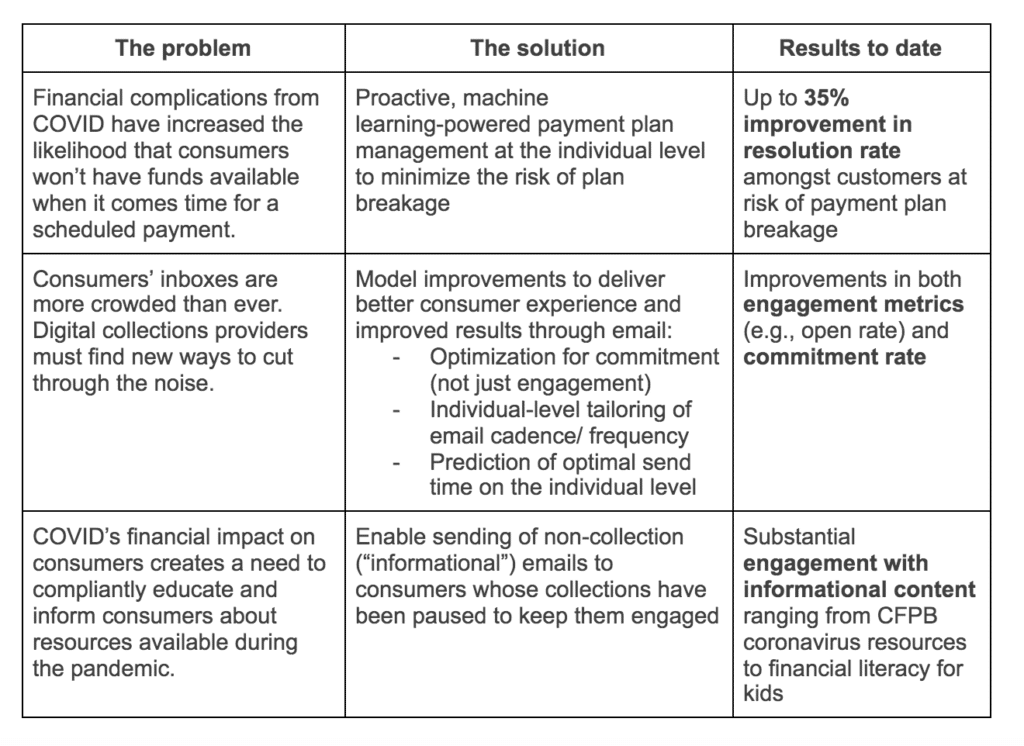
To demonstrate how the flywheel is used in practice, the TrueAccord product team walked through a series of case studies that demonstrated the value of an innovation methodology:
The Takeaway The future of digital debt collections is one of superior results for creditors enabled through relevant, personalized, and empowering experiences at scale for consumers.
Forging that future requires a true innovation strategy: one that blends data analytics, deep consumer empathy, industry expertise, and continuous focus on compliance. TrueAccord has long been fortunate to be on the frontier of the possible, creating new ways to add value for both consumers and creditors.
Ultimately, the debt collections companies that embrace the “constant innovation” mindset of a tech startup are the ones best positioned to lead the industry forward.
TrueAccord is a machine-learning and Al-driven 3rd-party debt collection company that is reinventing debt collection. We make debt collection empathetic and customer-focused and deliver a great user experience.
Our digital-first approach to debt collection creates a cycle of collections growth:
1. Improve the perception of the industry
2. Provide a personalized experience
3. Build brand equity and collect