The Future of Collections & Compliance: A Conversation with TrueAccord’s Associate General Counsel and Director of User Experience

By on October 5th, 2022 in Compliance, Customer Experience, Industry Insights, Industry Interviews, Product and Technology, User Experience, Webinars
Blog Header The Future of CC

Delivering communications to your customers has always been a compliance challenge with the plethora of laws, regulations, court decisions, and regulatory guidance in the debt collection space. Today with more communication channels available and regular communication from debt collection regulators—via consent orders, compliance bulletins, supervisory highlights, and even press releases—your compliance management systems and design must be flexible and easy to update.

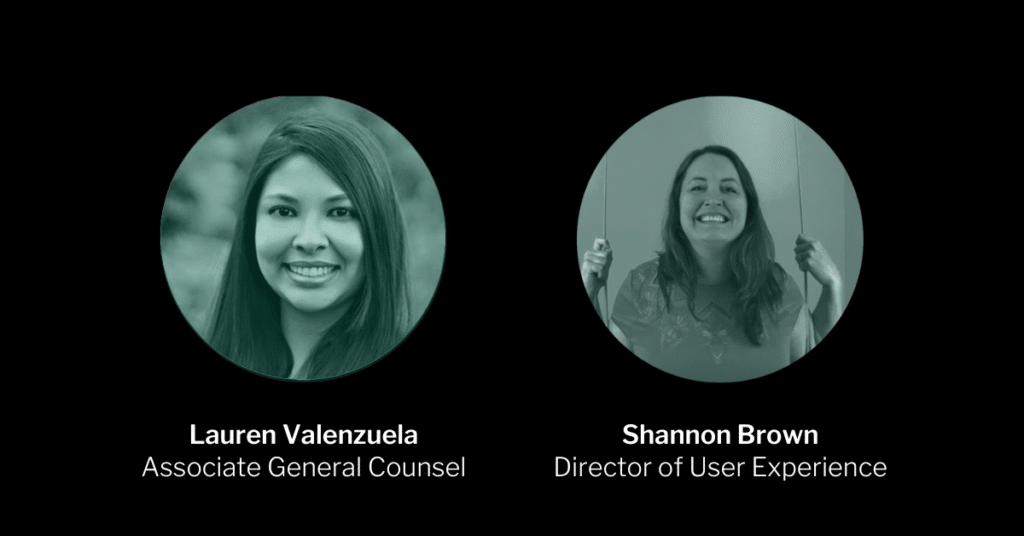
To get expert insights on the newest compliance issues and opportunities that need to be front of mind when sending digital communications to effectively engage your customers, Associate General Counsel Lauren Valenzuela and Director of User Experience Shannon Brown teamed up to discuss the Future of Collections & Compliance in TrueAccord’s latest webinar.

Watch the full webinar on-demand here»»

Below are some of the key takeaways from their discussion, plus attendee poll results on top compliance questions.

Speakers

*This blog is not legal advice. Legal advice must be tailored to the particular facts and circumstances of each unique matter.

The Current State of Compliance

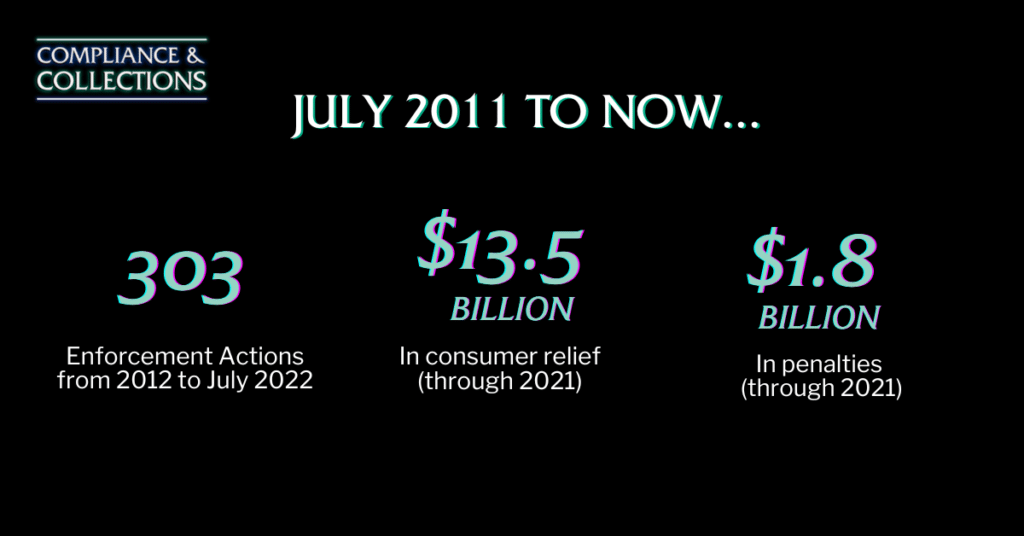
Lauren Valenzuela [LV]: Needless to say, over the last 10 years the CFPB has fundamentally changed how we think about and approach compliance. That has really influenced our industry and how we think about communications in debt collection.

July to Now

LV: Over the last decade the CFPB has taught us that compliance is an evolving thing. It’s not something that you can set and forget. It is something that is dynamic and that must constantly evolve and mature in order to be effective, because our environment is constantly changing.

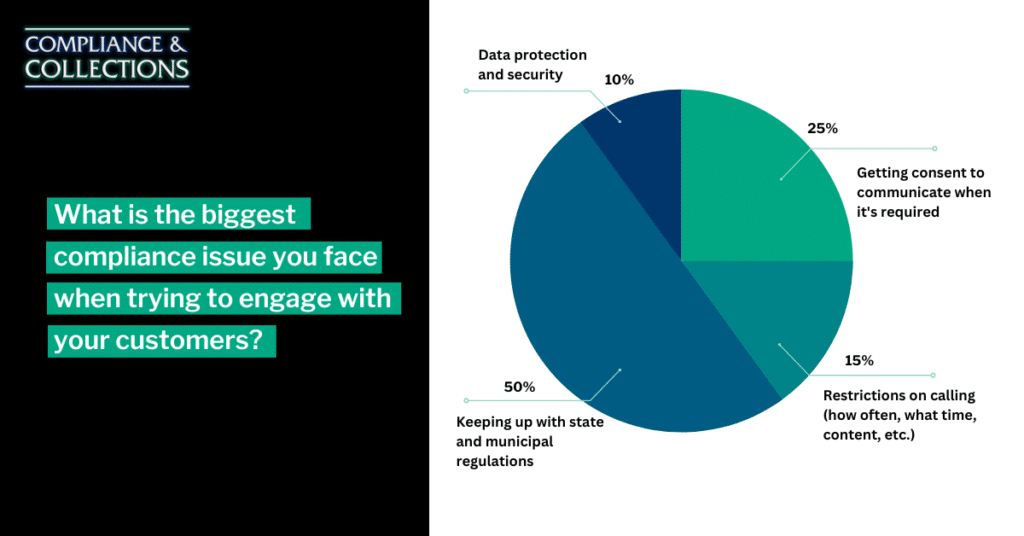
Attendee Poll Question: What is the biggest compliance issue you face when trying to engage with your customers?

POLL Q1

Changing Consumer Preferences for Collection Communications

LV: The CFPB recently published a blog and shared that it is a “mobile first” agency, meaning that most people who visit its website are using mobile devices or smartphones. Here at TrueAccord, what does our information show about mobile usage?

Shannon Brown [SB]: Consumer mobile use has skyrocketed. In 2016, about a quarter of our consumers were using their phones to read emails and visit our website—and that number has increased to consistently above 80%. We’ve put a lot of effort into making sure our emails and website are responsive to make sure we’re meeting the needs of our consumers who are overwhelmingly on mobile. We’ve made sure our pages are able to load faster for consumers that have less stable cell connections and really made sure our interactive elements are big and optimized for tapping with a finger instead of clicking with a mouse. As far as communications, our consumer research has really shown that most consumers don’t answer the phone and want to be contacted through digital channels—they want a multi-channel experience.

LV: So we’re seeing consumers increase use in mobile phones. Even the Bureau has seen that, and we’re seeing banks increase their use of digital technologies to communicate and facilitate transactions and engage with their consumers as well.

What’s the Role of the Legal Team in Your Collections Strategy?

LV: There needs to be a partnership between compliance and pretty much all core functions, and especially at a fintech company like TrueAccord where our technology and our digital communications platform are the center of what we do to help consumers. It’s really neat to see compliance interwoven, and I think that’s reflective of its compliance management system and company culture.

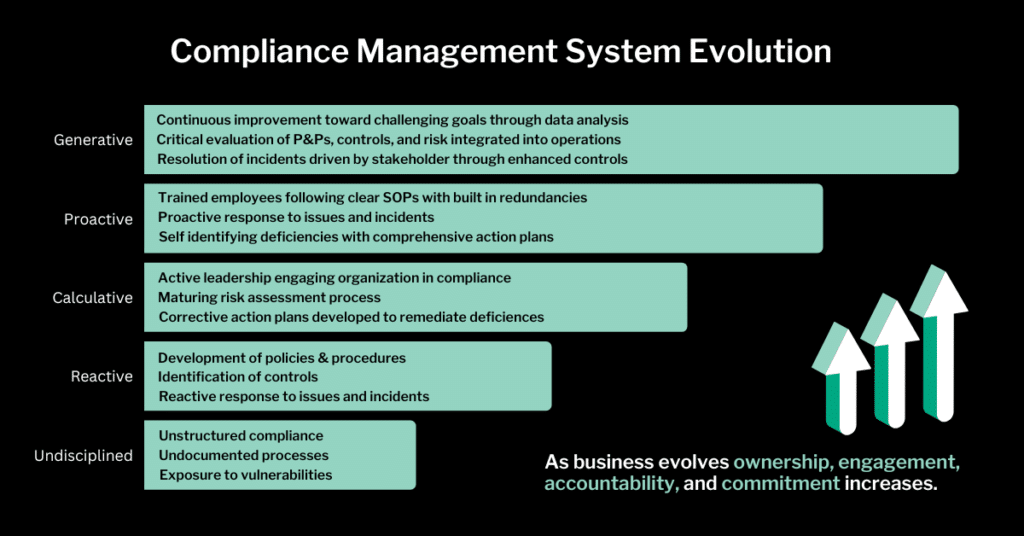
Compliance Management System Evolution

POLL Q2 CHART

LV: Ten years ago, many collection agencies were likely in the undisciplined stage, where there was some type of compliance ongoing, but it didn’t have much structure—processes may be undocumented, potential exposure to vulnerabilities that expose themselves on lawsuits, for example.

The next iteration is reactive, meaning there is development of some policies and procedures, controls are identified, and the company is responding to issues and incidents reactively.

The next level is calculative. At this level, leadership is actively engaging the organization in compliance, risk assessment processes are maturing, corrective action plans are being developed and executed to remediate deficiencies.

This next level is proactive, meaning employees are trained and following clear policies and procedures, and such procedures have built in intentional redundancies. The organization is being proactive in identifying and responding to issues and incidents and is self-identifying deficiencies and essentially executing on comprehensive corrective action plans.

Generative means that there’s continuous improvement towards challenging goals, which are driven by data analysis. There’s critical evaluation of policies and procedures and controls, and risk is integrated in operations. Issues and incidents resolutions are driven by stakeholders and really enhanced controls.

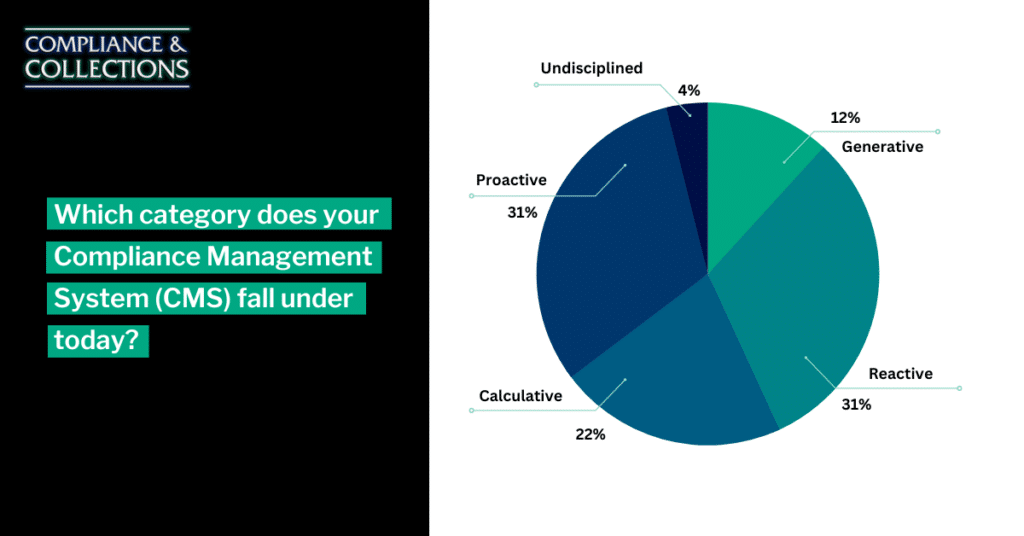
Attendee Poll Question: Which category does your Compliance Management System (CMS) fall under today?

POLL Q2

LV: So no matter where you’re at within your compliance management system and no matter what maturity level, the important thing to remember is that you don’t have to stay there—you can evolve. We can’t stress this enough. Compliance is an evolving and dynamic thing, and should be constantly evolving to stay effective in whatever environment it is in.

The fact that TrueAccord has a well-oiled compliance management system allows us to study that climate and then figure out how to translate it and make tangible improvements in our consumers’ experience. That’s something we encourage everyone to do: think about the consumer experience and the environment you’re collecting in, because it looks remarkably different than it did five years ago for example, and we should all be evolving.

The Product Perspective

LV: How has the CFPB influenced how we develop our products here at TrueAccord?

SB: Compliance has been built into our product development life cycle. Besides frequent meetings with our compliance team for feedback and approvals throughout the life cycle, we’ve designed and built our product so we can be nimble in responding to regulatory changes, which we know happen a lot.

LV: There are numerous federal, state, and local laws. Can you give some insight into how we at TrueAccord keep up with all of that?

SB: One of the ways we efficiently keep up with the requirements is through our code-driven approach.

But what does that mean practically? It means, for example, that for any phone call coming in, our agent knows exactly what disclosures need to be given to that consumer via our system, and then gives them an opportunity to log it. It means that any email that goes out has all the necessary disclosures appended, such as out of statute disclosures, state disclosures, et cetera, and these are all kept in our code base. Not only does it take the guesswork out of the equation for our agents and our content team that’s sending communication, it reduces human error. It also means that anytime anything needs to be updated, for example, a wording in a disclosure or when a new disclosure needs to be added, we can do it in one place instead of across a variety of templates and areas of the website. We can do it in one place and then that change propagates throughout the system. This helps us to react to changes really quickly.

Our compliance team is involved in every aspect of the process. They start as educators for the whole product team—we’re all aware of regulatory considerations and know where and when we need to ask for feedback and approvals from our compliance team. So they aren’t just making sure that agents are acting compliantly, but that the product team has that knowledge as well.

And as a product team, we have this wonderful research function that’s constantly talking to consumers and trying to understand their needs and asking for feedback, which we share with our compliance team so that they can go and advocate for consumers when they are talking with regulators and legislators

Future Forecast: Where is Compliance Heading in the Collections Industry?

LV: The next iteration of compliance can be seen in some of the recent CFPB and FTC activity. Last year in 2021 for example, the CFPB published a new section of its supervision and examination manual, specifically an information technology focused compliance management review section. The Bureau is looking at any type of technologies that you may employ, like machine learning models, algorithms, or analytics.

If you’re using any kind of algorithms or machine learning to help inform any aspect of your collection strategy—or if any of your service providers are using any type of algorithms or machine learning to help provide a service to you—you must pay attention to this section of the manual because it’s incredibly informative. We’re seeing the CFPB and the FTC addressing companies’ use of data and technology, wanting to make sure that companies have proper governance and oversight of it.

All of this recent activity shows how compliance within any company, more than ever before, must really take a cross functional approach to its work in order to keep up with the evolving environment. The compliance function should not be siloed. It really needs to be in partnership with all different disciplines and functions within the organization. We’re seeing right here and now and into the future, your information technology professionals, your information security professionals, your product professionals, your engineers, your data scientists, anybody who looks, touches, thinks about data and technology should all be working with compliance

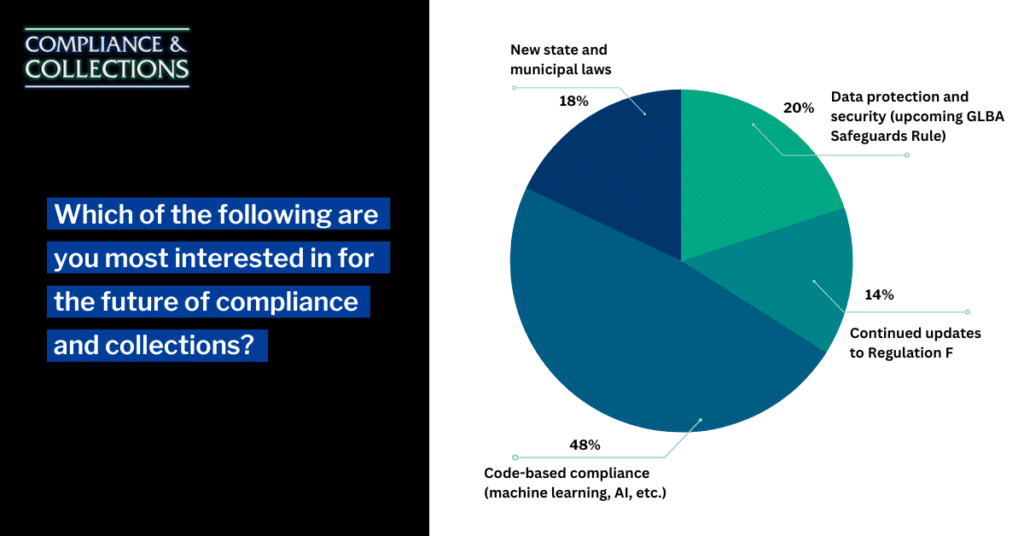
Attendee Poll Question: Which of the following are you most interested in for the future of compliance and collections?

POLL Q3

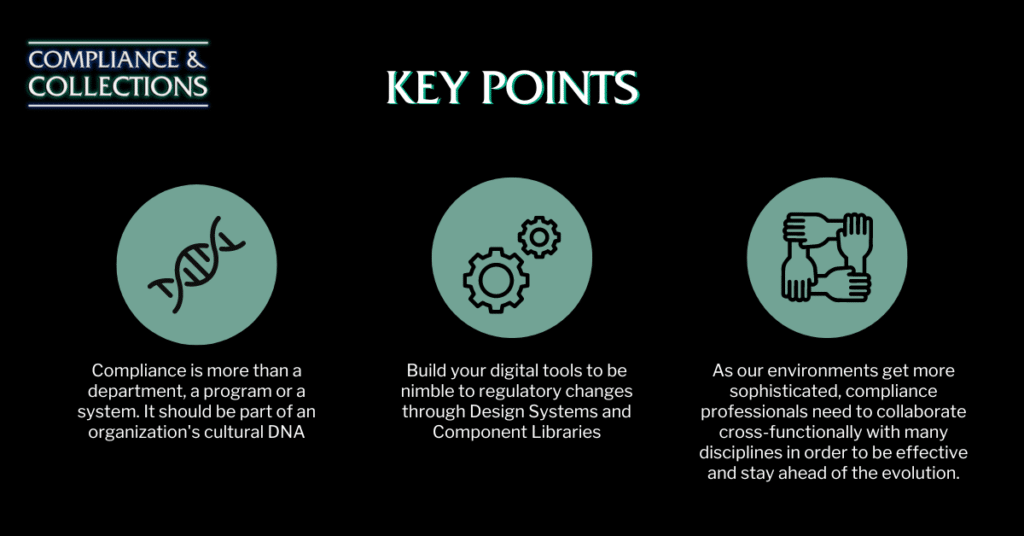
Three Key Takeaways

LV: Compliance is more than a department, it’s more than a program, it’s more than a system. It should be part of an organization’s cultural DNA. So when you think about compliance, wherever you are within an organization, think about how you can make it part of your organization’s DNA.

SB: Concentrate on building your tools to be nimble to the regulatory changes. Things like the design systems and the component libraries that allow you to make those changes quickly and easily, and make sure that they’re made everywhere across the system so you don’t have those older disclosures hanging out somewhere that someone forgot to change. Build your tools so you can make changes in one place efficiently.

LV: As our environments get more sophisticated around us, compliance professionals need to collaborate cross functionally more and more with other disciplines within a company to be effective and stay ahead of the evolution.The more the industry uses data and technology, we have a responsibility to make sure that it is being used in accordance with the law and best practices.

Key Points

Have more questions about compliance in collections? Schedule a consultation with TrueAccord to learn more»»

TrueAccord Digitally Serves 20 Million Consumers on Path to Financial Health

By on July 12th, 2022 in Company News, Customer Experience, Machine Learning, Product and Technology
HB Blog Header 1920 × 1080 px 1

With more than 20 million consumer accounts serviced through intelligent, digital-first collections products, results show better repayment and happier customers than “call to collect” agencies

LENEXA, Kan., July 12, 2022 — TrueAccord Corp, a debt collection company using machine learning-powered digital recovery solutions, today announced that it has served more than 20 million customers in debt with a digital-first experience. TrueAccord’s customer-centric approach and commitment to creating a positive consumer experience is reflected in its 4.7 Google customer satisfaction rating, customer feedback, and an A+ rating with the Better Business Bureau.

TrueAccord’s collection solutions harness machine learning and digital-first communications to deliver a personalized, consumer-friendly experience for those in debt. As is the nature of machine learning, the system dynamically analyzes and refines the approach used for each customer based on their interactions combined with years of previous engagement data in order to deliver the most effective communication treatment. The patented system, HeartBeat, which is now 20 million customer engagement interactions strong since its 2013 inception, continues to optimize with each new customer interaction.

“Machine learning is only as good as its data sources, and with more than 20 million accounts’ worth of engagement data that informs the HeartBeat system, we’re confident that the experiences being delivered are as streamlined and as aligned to consumer preferences as possible,” said Mark Ravanesi, CEO of TrueAccord Corp. “As a mission-driven company, we prioritize creating better experiences for consumers in debt, and based on our high customer satisfaction and repayment rates, it looks like we’re making significant progress.”

Powered by TrueAccord’s industry-leading tech stack, the product suite includes Retain, a client-branded early-stage consumer engagement platform for managing pre-charge off debt, and Recover, a full-service debt collection solution. Key benefits of both products include a simple, intuitive and effortless-to-use digital platform leading to great user experience, constant A/B testing and optimization to reduce friction and boost conversion rate, infinite scalability, and second-to-none channel deliverability. 

While holding customer experience as a priority, TrueAccord products continue to prove more effective than competitors, as evidenced by client case studies showing 25-35% better performance on accounts using Recover when compared to those placed with traditional agencies, and recovering $17 million in delinquent bills with a 44% paid in full rate using Retain.

To learn more about TrueAccord and its digital-first recovery solutions, visit www.TrueAccord.com and follow on Twitter and LinkedIn.

About TrueAccord

TrueAccord is the intelligent, digital-first collection and recovery company that leaders across industries trust to drive breakthrough results while delivering a superior consumer experience. TrueAccord pioneered the industry’s only adaptive intelligence: a patented machine learning engine, powered by engagement data from over 20 million consumer journeys, that dynamically personalizes every facet of the consumer experience – from channel to message to plan type and more – in real-time. Combined with code-based compliance and a self-serve digital experience, TrueAccord delivers liquidation and recovery rates 50-80% higher than industry benchmarks. The TrueAccord product suite includes Retain, an early-stage recovery solution, and Recover, a full-service debt collection platform.

Flipping the Script: Collecting with Kindness

By on April 21st, 2022 in Industry Insights, Customer Experience
Blog FlippingTheScript v2

Historically, debt collectors have been depicted as hostile, intimidating or downright rude – and over the years they’ve confirmed those stereotypes through aggressive phone calling and deceptive tactics. But to what success and at what cost? We know there’s a better way. The idea of compassionate, considerate consumer communication is behind TrueAccord’s approach to debt recovery and drives our innovation, and based on what we’ve seen, we believe there’s a lesson to be learned for others in the debt collection space. 

In collaboration with OnePoll, TrueAccord recently surveyed consumers about their financial regrets and found that 63% of respondents had some amount of money in collections. While 88% of respondents didn’t have any past experience with accounts in debt collection to report, the 12% that did weren’t so lucky, and their experiences were pretty awful. We don’t like to hear about consumers being treated badly and reading these consumer comments brings to light the problem we’re trying to solve. 

So what are consumers’ complaints about their experiences with debt collectors? Here are just a few:

  • “A million phone calls a day.”
  • “I was disgraced in a public place.”
  • “Relentless and rude, judgemental and uncaring.”
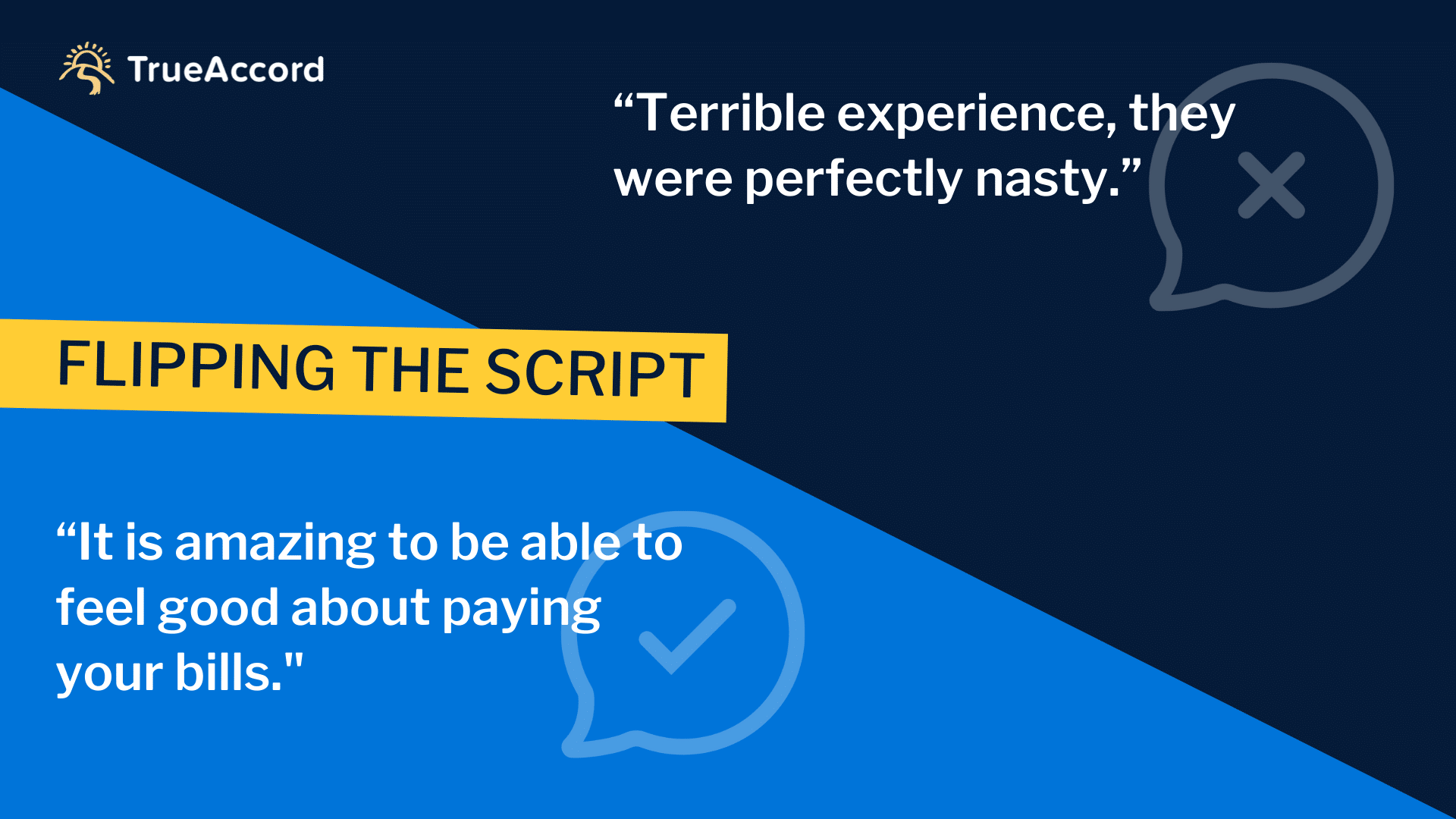
  • “Terrible experience, they were perfectly nasty.”
  • “They are mean and evil and clever and make you feel terrible about yourself.”
  • “They get angry when I don’t have the money to pay back in time.”

We’re here to flip the script. At TrueAccord, we don’t call consumers to collect past due debts, and we certainly don’t threaten or harass. By using a digital-first communication approach and friendly, humane messages, we actually connect with consumers and they feel empowered and motivated to pay. 

Don’t believe us? Here’s some real-life customer feedback from people TrueAccord has helped out of debt:

  • “Thank you for your patience and understanding!”
  • “Love the email communication and the ability to pay online.”
  • “I actually looked forward to making payments because I felt there was a sense of mutual respect between myself and TrueAccord. It felt good to take care of a lingering debt.”
  • “Thank you for your kindness, patience and professionalism in the wake of hardship.”
  • “It is amazing to be able to feel good about paying your bills. You helped me all the way. No pressure.”
  • “My experience with TrueAccord was seamless. Truth be told, it’s the first time I’ve ever enjoyed time spent with a debt collection company!”

So far the kindness approach has worked for TrueAccord – with more than 16 million customers served, we pride ourselves on our 4.7 on Google reviews, A+ rating with the BBB, and overwhelmingly positive customer feedback, not to mention our industry-leading recovery results. We’re proving that when you treat consumers with respect and kindness you can actually achieve better results for your business and customers.

Interested in finding out more about how outbound calling for debt collection is a thing of the past, our approach to digital-first debt collection and how it can work for your business? Check out “Outbound Calling Doesn’t Work, Here’s What Does” for more.